
Technology
What is Machine Learning? A Simple Beginner’s Guide with Real-Life Examples


In today’s fast-growing digital world, almost everything around us is becoming “smart.” From the recommendations you see on YouTube and Netflix, to Google Maps suggesting the fastest route, and even Instagram showing you reels based on your interest—there is a powerful technology working silently behind the scenes. This technology is called Machine Learning.
If you are completely new to this topic, don’t worry. This guide is specially written in a simple and easy-to-understand way for beginners, especially for Indian students, professionals, and anyone curious about technology.
At its core, What is Machine Learning can be understood as a method that allows computers to learn from data and improve their performance over time without being explicitly programmed for every task. Instead of writing fixed rules, we allow machines to learn patterns from examples.
For example, instead of telling a computer “this is spam” or “this is not spam” for every email, we show it thousands of emails, and it learns how to detect spam on its own.
In this blog, we will explore What is Machine Learning, how it works, real-life examples, types, applications in India, career opportunities, tools, and much more in a very simple and practical way.
What is Machine Learning?
To clearly understand What is Machine Learning, let’s break it down into simple terms:
Machine Learning is a branch of Artificial Intelligence (AI) that enables computers to learn from data and make decisions or predictions without being manually programmed for each situation.
Instead of hardcoding instructions, we give machines:
- Data (examples)
- Algorithms (learning methods)
- Feedback (to improve accuracy)
Over time, the system becomes better at performing tasks.
Simple Definition:
Machine Learning is a technology that helps computers learn from experience and improve automatically.
Example:
If you use Spotify or Gaana in India, the app recommends songs based on your listening history. It learns your taste in music and improves recommendations over time. That is Machine Learning in action.
Why is Machine Learning Important Today?
Understanding What is Machine Learning is important because it is transforming almost every industry in India and around the world.
Here are some key reasons why it matters:
1. Automation of Tasks
Machine Learning helps automate repetitive tasks like data entry, email filtering, and customer support.
2. Better Decision Making
Businesses use ML to analyze data and make smarter decisions.
3. Personalization
Apps like Amazon India, Flipkart, and Swiggy use ML to show personalized recommendations.
4. Fraud Detection
Banks in India use ML to detect suspicious transactions instantly.
5. Growth of AI Jobs
Machine Learning has created thousands of job opportunities in India’s IT sector.
How Does Machine Learning Work?
To fully understand What is Machine Learning, we must understand how it works step by step.
Step 1: Data Collection
Everything starts with data. This data can be:
- Images
- Text
- Numbers
- Videos
Example: Flipkart collects data about what users search and buy.
Step 2: Data Cleaning
Raw data is messy. It needs to be cleaned by removing errors and irrelevant information.
Step 3: Training the Model
A machine learning algorithm is trained using data. It learns patterns and relationships.
Step 4: Testing
After training, the model is tested with new data to check accuracy.
Step 5: Prediction
Finally, the model makes predictions or decisions.
Example:
A trained model can predict whether a customer will buy a product or not.
Types of Machine Learning
When learning What is Machine Learning, it is important to know its main types.
1. Supervised Learning
In supervised learning, the machine is trained using labeled data.
Example:
- Emails labeled as spam or not spam
- House prices based on size and location
Common algorithms:
- Linear Regression
- Decision Trees
- Support Vector Machines
2. Unsupervised Learning
Here, data is not labeled. The machine finds hidden patterns.
Example:
- Grouping customers based on buying behavior
- Market segmentation in Indian e-commerce
Algorithms:
- K-Means Clustering
- Hierarchical Clustering
3. Reinforcement Learning
In this type, the machine learns by trial and error using rewards and penalties.
Example:
- Training robots
- Self-driving cars
Real-Life Examples of Machine Learning in India
To better understand What is Machine Learning, let’s look at real-life Indian examples:
1. Swiggy and Zomato
They use ML to:
- Suggest restaurants
- Estimate delivery time
- Optimize delivery routes
2. Amazon India & Flipkart
They use ML for:
- Product recommendations
- Search optimization
- Fraud detection
3. Paytm and PhonePe
They use ML for:
- Fraud detection
- Transaction security
- Personalized offers
4. YouTube and Instagram
They use ML to:
- Recommend videos
- Show personalized feeds
5. Indian Railways & IRCTC
ML helps in:
- Predicting ticket demand
- Managing waitlists
Applications of Machine Learning
Machine Learning is used in almost every field today.
1. Healthcare
- Disease prediction
- Medical image analysis
- Drug discovery
Example: Predicting diabetes risk using patient data.
2. Education
- Personalized learning apps
- Automated grading systems
3. Banking & Finance
- Loan approval prediction
- Fraud detection
- Credit scoring
4. Agriculture (Important for India)
- Crop yield prediction
- Soil quality analysis
- Weather forecasting
5. Entertainment
- Netflix recommendations
- Spotify playlists
What is Machine Learning in Simple Terms?
If we simplify What is Machine Learning, it is like teaching a child using examples.
For example:
If you show a child many pictures of cats and dogs, over time, the child learns to identify them.
Similarly, machines learn from data instead of being directly programmed.
Machine Learning vs Artificial Intelligence
Many beginners get confused between AI and ML.
| Artificial Intelligence | Machine Learning |
|---|---|
| Broad concept | Subset of AI |
| Focuses on smart machines | Focuses on learning from data |
| Can work without learning | Learns from experience |
So, Machine Learning is a part of Artificial Intelligence.
Tools and Technologies Used in Machine Learning
If you want to learn What is Machine Learning practically, you should know the tools used:
1. Programming Languages
- Python (most popular in India)
- R
2. Libraries
- NumPy
- Pandas
- Scikit-learn
- TensorFlow
- PyTorch
3. Platforms
- Google Colab
- Jupyter Notebook
How to Start a Career in Machine Learning in India
Machine Learning is one of the fastest-growing career fields in India.
Step 1: Learn Basics of Programming
Start with Python.
Step 2: Learn Mathematics
- Statistics
- Linear Algebra
- Probability
Step 3: Learn Machine Learning Concepts
Understand algorithms and models.
Step 4: Practice Projects
- Spam email detection
- Movie recommendation system
- Price prediction models
Step 5: Build Portfolio
Upload projects on GitHub.
Job Roles in India:
- Machine Learning Engineer
- Data Scientist
- AI Developer
- Data Analyst
Salary Range in India:
- Freshers: ₹5–10 LPA
- Experienced: ₹15–40 LPA+
Future of Machine Learning in India
The future of Machine Learning in India is extremely bright. With Digital India, AI startups, and increasing internet users, demand is rising rapidly.
Industries like:
- E-commerce
- Healthcare
- Fintech
- EdTech
are heavily investing in ML technologies.
Soon, almost every company will use Machine Learning in some form.
Common Challenges in Machine Learning
Even though ML is powerful, it has challenges:
- Need large data sets
- Data privacy issues
- High computational cost
- Complex algorithms
What is Machine Learning in Everyday Life?
You may not realize it, but you use Machine Learning daily:
- Google Search predictions
- Face unlock on phones
- Voice assistants like Alexa
- Online shopping recommendations
- Spam filters in email
Conclusion
Now you clearly understand What is Machine Learning, how it works, and why it is so important in today’s world. Machine Learning is not just a technology—it is a revolution that is changing how we live, work, and interact with digital systems.
From Indian startups to global tech giants, everyone is using Machine Learning to improve services, increase efficiency, and provide better user experiences.
If you are a student or professional in India, learning Machine Learning can open doors to high-paying jobs and future-ready skills. The demand is only going to grow in the coming years.
So start learning today, practice consistently, and explore the exciting world of AI and Machine Learning.
FAQs about What is Machine Learning
What is Machine Learning in simple words?
Machine Learning is a technology that allows computers to learn from data and improve without being explicitly programmed.
Is Machine Learning difficult to learn?
It may seem complex at first, but with proper guidance and practice, it becomes easy to understand.
What is Machine Learning used for?
It is used in healthcare, banking, education, e-commerce, social media, and many other fields.
Do I need coding for Machine Learning?
Yes, basic programming knowledge (especially Python) is required.
Is Machine Learning a good career in India?
Yes, it is one of the highest-paying and fastest-growing career options in India.
What is the difference between AI and ML?
AI is the broader concept of smart machines, while ML is a method that helps machines learn from data.
Can beginners learn Machine Learning?
Yes, beginners can learn it step by step with the right resources and practice.



Finding skilled software developers has become increasingly challenging as businesses compete for top talent while trying to keep development costs under control. Whether you’re a startup building an MVP or an enterprise expanding your engineering capacity, hiring and retaining an in-house team isn’t always the most practical solution.
A dedicated development team offers an effective alternative. Instead of recruiting individual developers, you work with a specialized software development partner that provides a team of professionals focused exclusively on your project. This model combines flexibility, scalability, and access to global expertise, making it a popular choice for companies developing web, mobile, cloud, and enterprise applications.
In this guide, you’ll learn how a dedicated development team works, its advantages, potential challenges, cost considerations, and how to select the right partner for your business.
What Is a Dedicated Development Team?
A dedicated development team is a group of software professionals assigned exclusively to your project for a specific period. Unlike freelancers or project-based outsourcing, these experts work as an extension of your internal team, following your goals, processes, and priorities.
A typical dedicated team may include:
- Software Developers
- UI/UX Designers
- QA Engineers
- DevOps Engineers
- Business Analysts
- Project Managers
- Scrum Masters
- Solution Architects
The team collaborates closely with your stakeholders through regular meetings, sprint planning, code reviews, and progress updates to ensure the project stays aligned with your business objectives.
How Does a Dedicated Development Team Work?
The dedicated team model is designed for long-term collaboration rather than one-time project delivery.
The process generally follows these steps:
- Requirement Discovery
The development partner understands your business goals, technical requirements, expected timeline, and team size.
- Team Formation
Based on your project, specialists with relevant technical expertise are selected. You can also participate in interviews to ensure the team matches your expectations.
- Project Onboarding
The team gains access to documentation, repositories, communication channels, and development tools. Workflows and sprint schedules are established.
- Agile Development
Most dedicated teams follow Agile or Scrum methodologies with sprint planning, daily stand-ups, sprint reviews, and retrospectives.
- Continuous Scaling
As your product grows, developers, QA engineers, designers, or DevOps specialists can be added without restarting the hiring process.
When Should You Hire a Dedicated Development Team?
A dedicated development team is particularly valuable in the following situations:
Long-Term Software Development
If your project will continue evolving for months or years, maintaining a consistent team improves productivity and product knowledge.
Startup Product Development
Startups often need experienced developers without investing months in recruitment. A dedicated team enables faster product launches.
Limited Internal Resources
Businesses with small engineering departments can quickly expand development capacity without hiring permanent employees.
Digital Transformation Projects
Organizations modernizing legacy systems or building new digital platforms benefit from specialized expertise that may not exist internally.
Rapid Business Growth
When development needs change frequently, a dedicated team offers the flexibility to scale resources as required.
Benefits of Hiring a Dedicated Development Team
Access to Global Talent
Instead of limiting recruitment to your local market, you gain access to experienced professionals from around the world with expertise in modern technologies and frameworks.
Faster Hiring
Recruiting developers can take weeks or even months. A dedicated development partner can assemble a qualified team much faster, helping projects begin sooner.
Cost Efficiency
Hiring full-time employees involves salaries, benefits, office space, equipment, training, and recruitment expenses. A dedicated team eliminates many of these overhead costs while providing predictable monthly billing.
Scalability
As project requirements evolve, you can increase or reduce the team size without going through lengthy hiring or termination processes.
Better Focus
Unlike freelancers working on multiple projects simultaneously, dedicated developers focus entirely on your product, resulting in improved productivity and stronger collaboration.
Access to Specialized Skills
Need expertise in AI, cloud computing, cybersecurity, DevOps, or mobile development? Dedicated teams make it easier to access specialists without long-term hiring commitments.
Improved Product Quality
Established software development companies follow coding standards, automated testing, peer reviews, and quality assurance practices that contribute to more reliable software.
Challenges of the Dedicated Team Model
While the model offers many benefits, it’s important to understand potential challenges.
Communication Across Time Zones
Working with an offshore team may require overlapping working hours and well-defined communication processes.
Knowledge Transfer
Clear documentation and onboarding are essential to ensure developers understand business requirements and project goals.
Vendor Selection
Not all development partners provide the same level of expertise. Reviewing portfolios, technical capabilities, and client references is critical.
Project Management
Without proper planning and stakeholder involvement, even highly skilled teams can experience delays or changing priorities.
Fortunately, these challenges can be minimized through transparent communication, Agile practices, and choosing an experienced technology partner.
Dedicated Development Team vs Other Engagement Models
| Feature | Dedicated Team | Fixed Price | Staff Augmentation |
| Best For | Long-term projects | Small defined projects | Temporary skill gaps |
| Flexibility | High | Low | Medium |
| Team Control | High | Limited | High |
| Scope Changes | Easy | Difficult | Moderate |
| Scalability | Excellent | Limited | Good |
| Cost Predictability | High | High | Medium |
A dedicated team is generally the best choice for businesses developing products that require continuous improvement, feature expansion, and ongoing maintenance.
How Much Does a Dedicated Development Team Cost?
The cost depends on several factors rather than a fixed price.
These include:
- Team size
- Developer experience
- Technology stack
- Project complexity
- Engagement duration
- Location of the development team
For example, hiring senior engineers with expertise in AI or cloud architecture typically costs more than general web development.
Businesses should focus on overall value instead of hourly rates alone. An experienced team often delivers better software, reduces technical debt, and shortens development timelines, leading to lower total project costs.
When requesting proposals, ask vendors for a transparent breakdown of services, team composition, communication processes, and ongoing support.
How to Choose the Right Dedicated Development Partner
Selecting the right software development partner significantly impacts project success.
Consider the following factors:
Technical Expertise
Review the company’s experience with technologies relevant to your project, including programming languages, frameworks, cloud platforms, and development methodologies.
Industry Experience
A partner familiar with your industry understands common challenges, compliance requirements, and user expectations.
Portfolio and Case Studies
Examine previous projects to evaluate technical quality, design standards, scalability, and business outcomes.
Client Reviews
Independent reviews and testimonials provide valuable insight into communication, reliability, and project delivery.
Development Process
Look for partners using Agile methodologies, regular reporting, sprint planning, and transparent communication.
Security Standards
Ensure the company follows secure coding practices, signs NDAs, protects intellectual property, and complies with relevant data protection regulations.
Scalability
Your technology partner should be able to increase or decrease team size as business requirements change.
How to Collaborate Effectively with a Dedicated Development Team
To maximize project success:
- Define clear business goals.
- Assign a product owner or project stakeholder.
- Schedule regular sprint reviews.
- Use project management tools for transparency.
- Maintain clear documentation.
- Encourage continuous feedback.
- Measure performance using KPIs.
- Build long-term collaboration instead of treating the team as an external vendor.
Strong communication and shared objectives create a productive working relationship that benefits both parties.
Frequently Asked Questions
Is a dedicated development team suitable for startups?
Yes. Startups benefit from faster hiring, reduced recruitment costs, and access to experienced developers without building a large in-house engineering department.
How is a dedicated team different from outsourcing?
Traditional outsourcing focuses on delivering a predefined project, while a dedicated team works as an extension of your business with ongoing collaboration and greater control over priorities.
Can I scale the team later?
Yes. One of the biggest advantages of this model is the ability to add or reduce developers, designers, QA engineers, or DevOps specialists as project requirements change.
Who owns the source code?
Ownership should be clearly defined in the contract. Reputable software development companies transfer intellectual property and source code ownership to the client upon project completion or according to the agreement.
Which industries use dedicated development teams?
Dedicated teams are widely used in SaaS, healthcare, fintech, eCommerce, education, logistics, manufacturing, travel, and enterprise software development.
Conclusion
A dedicated development team is an excellent choice for organizations seeking long-term software development expertise without the complexity of building and managing a large in-house team. It offers access to skilled professionals, flexible scaling, predictable costs, and faster product delivery while allowing businesses to maintain greater control over development priorities.
Whether you’re launching a new digital product, modernizing existing software, or expanding engineering capacity, choosing the right development partner can significantly improve project outcomes. Evaluate technical expertise, communication practices, industry experience, and scalability before making your decision.
By treating your dedicated team as a true extension of your organization, you can build high-quality software, accelerate innovation, and achieve sustainable business growth.
In the current digital environment businesses require Web applications which deliver both strength and scalability and user-friendly interfaces. The full stack development company provides essential development services for this requirement. Full stack development delivers complete system operation through its front-end design and back-end system development.
The process of selecting a suitable service provider becomes challenging when multiple options exist. Let’s explore everything you need to know.
What is a Full Stack Development Company?
A full-stack development company provides complete software development services which include creating both the client-side and server-side components of software products. The companies develop products which range from basic websites to complex enterprise-grade applications.
The developers usually use these technologies for their work:
- Front-end: ReactJS, Angular, Vue.js
- Back-end: NodeJS, Python, PHP
- Database: MySQL, MongoDB
- DevOps & Cloud: AWS, Azure
The full stack companies provide complete solutions which remove the requirement for multiple teams to work on projects. This approach leads to faster project completion times while improving team collaboration.
Why Businesses Prefer Full Stack Development Services
- End-to-End Development
Full stack developers handle every stage of a project which includes planning design development testing and deployment.
- Faster Time to Market
The single team which handles all system components allows for better communication which leads to quicker project completion.
- Cost-Effective Solutions
The expenses of hiring a full stack development company prove to be more economical compared to operating two distinct teams for front-end and back-end development.
- Scalable Applications
These companies create systems which can expand according to your business requirements.
Key Services Offered by a Full Stack Development Company
A professional full stack development company typically offers:
✔ Custom Web Application Development
The company develops base solutions which they modify to meet their clients’ distinct business needs.
✔ Front-End Development
The team creates user interfaces which work on all devices by using current frameworks such as ReactJS.
✔ Back-End Development
The system developers construct strong server-side systems which include application programming interfaces to enable full operational performance.
✔ UI/UX Design
The designers create user interfaces which provide users with a smooth and interactive experience.
✔ API Integration
Full Stack Development Company: Why “End-to-End” Isn’t Enough Anymore
The common expectation for full stack development companies arises from businesses which seek them. The clients want all services which include front-end work and back-end work to be managed by the company. The reality shows that complete development services now serve as the fundamental requirement for business operations.
The current worth of a full stack partner depends on their ability to understand business goals and their capacity to speed up product development and their services which minimize technical decision-making exhaustion.
The process of selecting an appropriate development partner requires examination of essential factors which need evaluation.
The Shift: From Coding to Problem-Solving
The development companies of the past dedicated their efforts to code creation. The current full stack development services work to address business challenges through their solutions.
For example:
- The process of developing ReactJS interfaces requires more than interface development to achieve its goals.
- The process of developing an experience requires design work that turns visitors into customers.
- The system functions through APIs
- The system needs to develop scalable capabilities that maintain stability during expansion.
Top companies today combine:
UI/UX thinking + engineering + business logic.
What Top Full Stack Development Companies Do Differently
After analysing leading service providers, a clear pattern emerges.
- They Don’t Just Build — They Guide
The best teams don’t wait for instructions.
They help you:
- Choose the right tech stack
- Avoid over-engineering
- Focus on MVP-first execution
This reduces wasted time and budget.
- They Prioritize Speed Without Compromising Quality
Speed is no longer optional.
Modern workflows include:
- Agile development cycles
- Rapid prototyping
- Continuous testing & deployment
This means you can go from:
Idea → Working product in weeks, not months
- They Build for Scale from Day One
A good full stack development company doesn’t just build for today.
They ensure:
- Clean architecture
- Modular code
- Cloud-ready infrastructure
So, your product can grow without major rebuilds.
- They Combine Front-End Experience with Back-End Power
Great products don’t just work—they feel smooth.
That’s why top companies focus on:
- Fast-loading interfaces (ReactJS, Vue)
- Strong backend systems (NodeJS, APIs)
- Seamless integration between both
Core Services You Should Expect
A modern full stack development company should offer:
✔ Custom Web & App Development
Not templates—solutions built around your business model.
✔ UI/UX-Driven Development
Design that improves engagement, not just aesthetics.
✔ API & System Integration
Connecting tools, platforms, and services smoothly.
✔ Agile Development Process
Iterative development with continuous improvements.
✔ Industry-Specific Solutions
Tailored builds for sectors like healthcare, fintech, eCommerce, etc.
The Hidden Factor: Developer Quality vs Process
Here’s something most businesses overlook:
Tools and technologies don’t build great products—people do.
Top companies invest heavily in:
- Skilled full stack developers
- Strict talent screening
- Real-world project experience
This directly impacts:
- Code quality
- Project speed
- Long-term maintainability
Why Agile Methodology Is a Game-Changer
Both high-performing companies emphasize agile development, and for good reason.
Agile ensures:
- Faster feedback loops
- Better collaboration
- Continuous improvement
Instead of waiting months, you see progress every week.
Benefits of Hiring the Right Full Stack Development Company
Choosing the right partner gives you:
Faster Product Launch
Quick turnaround from concept to deployment
Cost Efficiency
One team instead of multiple vendors
Flexibility
Easy changes during development
Scalable Growth
Systems built to handle future expansion
Common Mistakes to Avoid
Many businesses make these mistakes:
Choosing based on price only
Ignoring communication and process
Overlooking scalability
Not validating technical expertise
Result: Delays, poor performance, and rebuild costs
How to Find the Best Full Stack Development Company
Before finalizing, ask:
- Do they understand your business goals?
- Can they suggest improvements (not just follow instructions)?
- Do they follow agile practices?
- Do they have proven experience across industries?
The right partner will challenge your ideas—not just execute them.
The Future of Full Stack Development
The role of a full stack development company is evolving rapidly.
Future trends include:
- AI-assisted development
- Faster no-code + full-code hybrid models
- More focus on performance and UX
- Increased demand for scalable SaaS products
The companies that adapt fastest will lead the market.
Conclusion:
A full stack development company has developed into a complete strategic partnership which extends beyond its previous role as a technical service provider.
The difference between a good and great company is simple:
One builds what you ask the other builds what your business actually needs.
The most important choice you will make for your organization is selecting a development partner which will drive your company towards faster growth and improved products and permanent success.

Manufacturing industries are increasingly adopting advanced technologies to improve production efficiency, reduce operational costs, and maintain consistent product quality. However, challenges such as production bottlenecks, unexpected equipment failures, inefficient process testing, and limited visibility into machine performance continue to affect manufacturing operations. Traditional monitoring and maintenance approaches often struggle to address these challenges because they rely on historical data and manual processes.
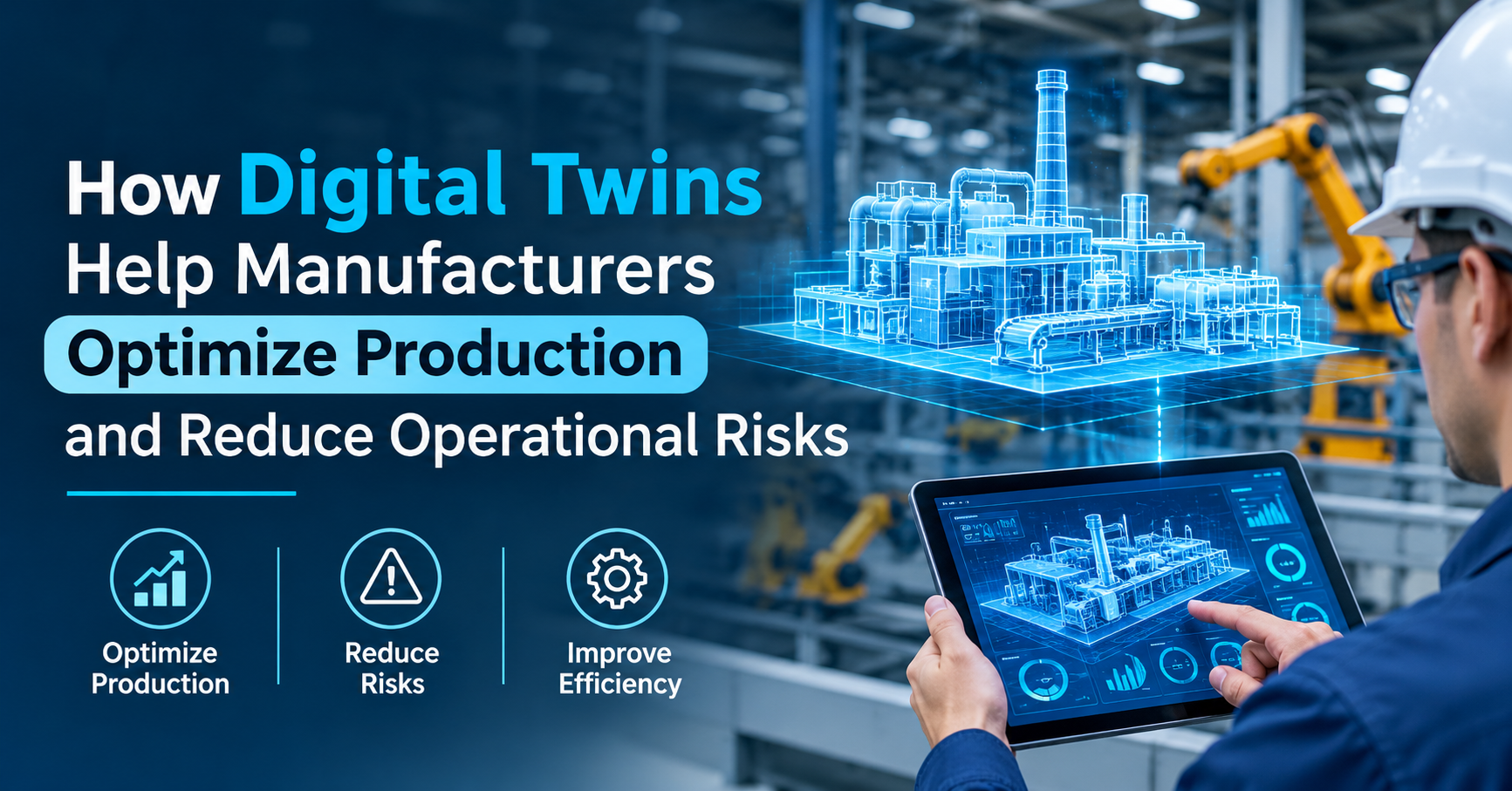
Digital twin technology is changing how manufacturers manage their production environments. By creating virtual representations of physical machines, production lines, and entire manufacturing facilities, digital twins allow businesses to monitor operations, simulate different scenarios, and make informed decisions using real-time data.
The growing adoption of digital twins in manufacturing is helping organizations move toward smarter, more connected, and data-driven production systems. From identifying process inefficiencies to predicting equipment failures, digital twins provide manufacturers with valuable insights that support operational optimization and risk reduction.
Let’s explore how digital twin technology is transforming manufacturing operations and helping businesses build more resilient production environments.
1. Understanding Digital Twins in Manufacturing
A digital twin is a virtual representation of a physical asset, process, or system that uses real-time and historical data to reflect the behavior and performance of its physical counterpart.
In manufacturing, digital twins can represent individual machines, production equipment, assembly lines, warehouse operations, or complete factory environments.
These virtual models are connected to physical assets through technologies such as:
- Internet of Things (IoT) sensors.
- Industrial automation systems.
- Cloud computing platforms.
- Artificial intelligence (AI) and machine learning.
- Data analytics and visualization tools.
Sensors installed on physical equipment collect information such as temperature, vibration, pressure, operating speed, and energy consumption. This data is transferred to the digital twin, allowing manufacturers to understand equipment conditions and production performance.
Unlike static simulations, connected digital twins can continuously reflect changes in physical operations, helping manufacturers make decisions based on current operational conditions.
2. Identifying Production Bottlenecks and Improving Workflow Efficiency
Production bottlenecks can significantly affect manufacturing productivity. When one machine or process operates slower than others, it can create delays throughout the production line, resulting in missed deadlines, increased operational expenses, and reduced output.
Digital twins help manufacturers identify these bottlenecks by providing a comprehensive view of production activities.
By analyzing real-time operational data, manufacturers can understand how machines interact, identify delays, and determine which production stages are limiting overall output.
For example, a digital twin of an automotive assembly line can reveal that a particular workstation requires more processing time than other stations. Managers can use this information to adjust workflows, redistribute workloads, or improve equipment utilization.
Key benefits include:
- Real-time production monitoring.
- Identification of underperforming processes.
- Improved resource allocation.
- Reduced production cycle times.
- Better coordination between manufacturing stages.
This data-driven approach helps businesses improve production efficiency without relying entirely on costly physical experiments.
3. Predictive Maintenance to Reduce Equipment Downtime
Unexpected equipment failures are among the biggest operational risks in manufacturing. A malfunctioning machine can interrupt production schedules, increase maintenance expenses, and affect product delivery timelines.
Traditional maintenance approaches often depend on fixed maintenance schedules or repairs after equipment failure. Both approaches can result in unnecessary costs or unexpected downtime.
Digital twins support predictive maintenance by continuously monitoring equipment conditions and analyzing performance data.
For instance, sensors can collect vibration and temperature readings from industrial motors. The digital twin analyzes these readings to identify unusual patterns that may indicate developing mechanical problems.
When combined with AI and machine learning, digital twin systems can help predict potential equipment issues and support timely maintenance planning.
Manufacturers can benefit from:
- Early identification of equipment abnormalities.
- Reduced unexpected machine breakdowns.
- Better maintenance scheduling.
- Extended equipment lifespan.
- Lower repair and maintenance costs.
Predictive maintenance helps manufacturers shift from reactive repairs to proactive equipment management, improving operational continuity.
4. Simulating Production Processes Before Implementation
Testing changes directly on a physical production line can be expensive and time-consuming. A new machine configuration, production sequence, or workflow adjustment may introduce unexpected problems if it has not been evaluated properly.
Digital twins provide manufacturers with a virtual environment where they can test different scenarios before implementing changes in real-world operations.
For example, manufacturers can simulate the introduction of new equipment, changes in production capacity, or modifications to assembly line configurations. They can evaluate how these changes might affect production speed, resource consumption, and equipment utilization.
This approach offers several advantages:
- Reduces the need for repeated physical testing.
- Minimizes production interruptions.
- Helps identify potential process limitations.
- Supports better investment decisions.
- Improves production planning and configuration.
By testing ideas in a virtual environment, manufacturers can make more informed decisions while reducing the risks associated with operational changes.
5. Improving Equipment Performance Through Real-Time Insights
Manufacturing equipment must operate efficiently to maintain productivity and product quality. However, limited visibility into machine performance can make it difficult to identify inefficiencies and optimize operating conditions.
Digital twins provide centralized access to equipment performance information through connected monitoring systems and analytical dashboards.
Manufacturers can track important operational parameters, including:
- Machine operating speed.
- Temperature and pressure levels.
- Energy consumption.
- Equipment utilization.
- Production output.
- Operating conditions and performance variations.
These insights help production managers understand how equipment performs under different operating conditions.
For example, if a machine consistently consumes more energy than expected, manufacturers can investigate possible causes such as excessive operating loads, inefficient configurations, or maintenance requirements.
With continuous monitoring and performance analysis, businesses can improve equipment utilization, reduce energy waste, and maintain more consistent production output.
6. Enhancing Product Quality and Reducing Manufacturing Defects
Maintaining consistent product quality is essential for manufacturers operating in competitive markets. Defective products can increase material waste, create rework requirements, and negatively affect customer satisfaction.
Digital twins help improve quality management by connecting production data with virtual process models.
Manufacturers can monitor process parameters and identify conditions that may contribute to product defects. For example, temperature variations, pressure inconsistencies, or incorrect machine settings may affect the quality of manufactured components.
By analyzing these variables, digital twin systems help businesses understand the relationship between production conditions and product quality.
When integrated with AI-powered analytics, digital twins can also help identify unusual patterns and potential quality issues before they become widespread.
This supports better process control, reduced material waste, and more consistent manufacturing outcomes.
7. Strengthening Operational Risk Management
Manufacturing environments involve several operational risks, including equipment failures, production interruptions, inefficient resource utilization, and unexpected changes in operating conditions.
Digital twins help organizations understand these risks by providing a virtual environment for analyzing different operational scenarios.
Manufacturers can evaluate how production systems may respond to equipment failures, increased workloads, supply interruptions, or changes in operating conditions.
This allows management teams to develop contingency plans and identify areas that require additional attention.
Digital twins also support better decision-making by providing data-driven insights instead of relying exclusively on assumptions or manual observations.
As a result, manufacturers can improve operational preparedness, minimize disruptions, and build more resilient production systems.
8. Supporting Industry 4.0 and Smart Manufacturing Initiatives
Digital twin technology is an important part of the Industry 4.0 ecosystem. It works alongside IoT, artificial intelligence, robotics, cloud computing, and industrial automation to create interconnected manufacturing environments.
However, successfully implementing these technologies requires a clear digital transformation strategy.
Manufacturers must evaluate their existing infrastructure, identify suitable applications, establish reliable data connections, and ensure that new systems can communicate with existing equipment.
Working with an experienced Industry 4.0 consulting company can help businesses plan and implement digital transformation initiatives more effectively.
Professional consulting support can assist manufacturers in identifying automation opportunities, integrating connected technologies, improving operational visibility, and developing scalable smart manufacturing solutions.
This structured approach helps organizations adopt digital twin technology while aligning investments with long-term business objectives.
Conclusion
Digital twin technology is transforming modern manufacturing by helping businesses gain deeper insights into production operations, improve equipment performance, and reduce operational risks.
Through real-time monitoring, predictive maintenance, virtual process simulation, and data-driven analysis, digital twins help manufacturers identify bottlenecks, minimize downtime, improve product quality, and optimize resource utilization.
As manufacturing environments become increasingly connected and automated, adopting digital twins can provide businesses with a significant operational advantage.
By combining digital twin technology with IoT, AI, and Industry 4.0 strategies, manufacturers can build more efficient, flexible, and resilient production systems. Investing in the right digital transformation approach today can help businesses improve productivity, control operational costs, and prepare for the future of smart manufacturing.
Also Read: Custom Software Development Houston: Building Scalable Digital Solutions for Modern Businesses
FAQs
1. What are digital twins in manufacturing?
Digital twins in manufacturing are virtual representations of physical machines, production lines, or factory systems that use real-time data to monitor performance and analyze operations.
2. How do digital twins improve manufacturing efficiency?
They help identify production bottlenecks, optimize workflows, monitor equipment performance, and simulate process changes before implementing them physically.
3. Can digital twins reduce equipment downtime?
Yes. When integrated with IoT sensors and predictive analytics, digital twins can identify unusual equipment behavior and help manufacturers schedule maintenance before failures occur.
4. How do digital twins support Industry 4.0?
Digital twins connect physical manufacturing assets with digital technologies such as IoT, AI, cloud computing, and automation to support smarter, data-driven production environments.
5. Are digital twins suitable for small and medium-sized manufacturers?
Yes. Small and medium-sized manufacturers can begin with digital twins for specific machines or production processes and expand implementation as their operational requirements grow.

Improving Grid Reliability Through Accurate Generator Modeling and Testing

Movers Packers in Antwerp: Affordable & Reliable Services

Hertdip-10 Tablet: Effective Medicine for High Blood Pressure by Hertz Pharma, Mumbai, India

Make a Positive Impact with Increasingly Popular Candle Packaging

Explore the Royal Heritage of India with a 9 Nights 10 Days Rajasthan Tour Package

Rani No Hajiro in Ahmedabad: A Complete Guide to History, Shopping & Hidden Secrets

How to Get Promoted Faster at Work: Smart Career Growth Tips

Dublin City University: Everything You Need to Know Before Applying in 2026

Why Amazon Listing Services Are a Game-Changer for New Sellers in 2026








