
General
Fenbendazole for Cats: Dosage Chart by Weight (kg & lbs)

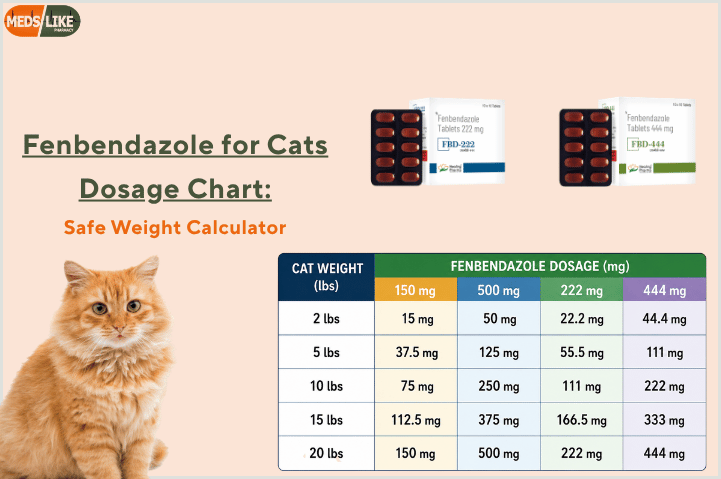
Fenbendazole is an antiparasitic medication used in veterinary medicine to help treat certain intestinal and respiratory parasite infections in cats. It belongs to the benzimidazole class of medications and works by interfering with the parasites’ ability to absorb nutrients and produce energy.
If you are researching fenbendazole for cats dosage chart by weight, it is important to understand that the correct dosage depends on the type of parasite, your cat’s weight, the medication’s concentration, and the veterinarian’s treatment plan.
This guide explains common veterinary dosing references, weight-based calculations, administration methods, and precautions to consider before treatment. You can also visit Medslike.com to explore general medication-related information and educational resources.
What Is Fenbendazole Used for in Cats?
Fenbendazole is a broad-spectrum deworming medication that may be prescribed to manage certain parasitic infections in cats. Depending on the product and veterinary treatment plan, it may be used against:
- Roundworms
- Hookworms
- Certain tapeworm species
- Lungworms
- Giardia infections
Not every parasite responds to fenbendazole. For example, common flea-associated tapeworm infections may require a different medication. Therefore, identifying the parasite through veterinary examination and fecal testing is important.
Fenbendazole for Cats Dosage Chart by Weight
Fenbendazole dosage is commonly calculated according to body weight in milligrams per kilogram (mg/kg).
For certain feline Giardia treatment protocols, veterinary guidelines reference 50 mg/kg orally once daily. The following table illustrates the mathematical calculation for that specific regimen.
Illustrative calculation only: This is not a universal dosing recommendation or a substitute for a veterinarian’s prescription.
| Cat’s weight | Weight in pounds | Calculated amount at 50 mg/kg |
|---|---|---|
| 1 kg | 2.2 lbs | 50 mg |
| 2 kg | 4.4 lbs | 100 mg |
| 3 kg | 6.6 lbs | 150 mg |
| 4 kg | 8.8 lbs | 200 mg |
| 5 kg | 11 lbs | 250 mg |
| 6 kg | 13.2 lbs | 300 mg |
| 7 kg | 15.4 lbs | 350 mg |
| 8 kg | 17.6 lbs | 400 mg |
The treatment duration varies according to the diagnosed infection. For Giardia, veterinary references commonly describe courses lasting 3–5 days or longer, depending on the clinical circumstances.
Do not use this table to determine the volume of liquid medication. Different fenbendazole for cats have different concentrations, so a veterinarian must confirm the appropriate product and amount.
How to Calculate Fenbendazole Dosage for Cats
The basic weight-based calculation is:
Required medication (mg) = Body weight (kg) × Prescribed dose (mg/kg)
For example, if a veterinarian prescribes 50 mg/kg for a cat weighing 4 kg:
4 kg × 50 mg = 200 mg per dose.
However, the actual quantity of liquid or granules depends on the product’s strength and formulation.
Always check the concentration printed on the packaging. Never assume that all fenbendazole suspensions, powders, or granules have the same strength.
How to Give Fenbendazole to Cats
Fenbendazole is generally administered orally in suitable veterinary formulations. Depending on the product, it may be available as a liquid suspension, granules, or powder.
Here are some general administration tips:
- Weigh your cat accurately before treatment.
- Follow the veterinarian’s prescribed dose and schedule.
- Measure liquid medication using an appropriate oral dosing syringe.
- If permitted by the product instructions, mix the medication with a small amount of food.
- Make sure your cat receives the complete prescribed amount.
- Follow the full treatment course, even if symptoms improve.
If your cat refuses medication, ask your veterinarian about alternative administration methods rather than changing the dose.
Possible Side Effects of Fenbendazole in Cats
Fenbendazole is generally well tolerated when administered appropriately. However, some cats may experience mild adverse effects.
Possible side effects include:
- Vomiting
- Diarrhea
- Excessive salivation
- Temporary appetite changes
- Digestive discomfort
Rarely, more serious reactions may occur. Facial swelling, difficulty breathing, severe weakness, or collapse require immediate veterinary attention.
Longer-than-recommended treatment courses should be avoided unless specifically prescribed and monitored by a veterinarian.
Precautions Before Giving Fenbendazole to Cats
Before starting treatment, consider these important precautions:
1. Confirm the parasite: Different worms require different medications. A fecal examination can help identify the infection.
2. Check your cat’s weight: Accurate body weight is essential for safe medication calculations.
3. Consider age and health: Kittens, elderly cats, and cats with existing illnesses may need additional veterinary assessment.
4. Check pregnancy and nursing status: Discuss treatment suitability with your veterinarian if your cat is pregnant or nursing.
5. Avoid self-medication: Never use a dog medication or a human formulation without confirming its suitability for cats.
6. Follow-up testing: Your veterinarian may recommend another fecal examination to determine whether the treatment has successfully controlled the infection.
When Should You Contact a Veterinarian?
Contact your veterinarian if your cat develops persistent diarrhea, repeated vomiting, blood in the stool, weight loss, or a swollen abdomen.
Seek urgent veterinary care if your cat becomes extremely weak, has difficulty breathing, collapses, or shows signs of severe dehydration.
Also, if symptoms continue after treatment, do not automatically repeat the medication. Persistent symptoms may indicate reinfection, an incorrect diagnosis, or another underlying condition.
Frequently Asked Questions
1. How much fenbendazole should I give my cat?
The amount depends on your cat’s body weight, the diagnosed parasite, product concentration, and prescribed treatment protocol. A commonly referenced Giardia regimen is 50 mg/kg once daily, but this should only be used under veterinary direction.
2. Can fenbendazole be given to kittens?
Fenbendazole may be prescribed for certain parasitic infections in kittens. However, age, weight, health status, and product suitability must be assessed by a veterinarian before treatment.
3. How many days should cats take fenbendazole?
Treatment duration depends on the parasite. Some veterinary protocols involve three consecutive days, while Giardia treatment commonly involves three to five days or longer. Follow the prescribed schedule.
4. Should fenbendazole be given with food?
Many oral fenbendazole formulations can be administered with food. Giving it with food may also help reduce digestive discomfort. Follow the specific product instructions.
5. Is fenbendazole safe for cats?
Fenbendazole is generally well tolerated in cats when used appropriately. However, incorrect dosing, unsuitable formulations, and inappropriate treatment durations can create risks. Veterinary guidance is recommended.
Final Thoughts
Fenbendazole can be a useful veterinary antiparasitic medication for managing certain infections in cats. However, the correct amount cannot be determined by weight alone. The parasite being treated, medication concentration, and individual health factors all matter.
Use the weight-based calculation chart as an educational reference rather than a self-treatment guide. Consult a veterinarian before starting medication, and explore Medslike.com for additional general medication information and educational content.




Buying cigars online should feel simple, but with so many flavors and pack sizes, it is easy to end up with something you do not enjoy. Backwoods are a good example. The range is wide, the style is distinctive, and a little knowledge goes a long way. This guide walks through how to choose well, avoid common mistakes and get the best experience from every cigar you buy.
Start With What the Cigar Is
A Backwoods is a slim cigar with a natural tobaccostock leaf wrapper. That wrapper gives it a rustic look and a mild earthy taste that stays present no matter which flavor you pick. Because the cigars are slim, they are quick to enjoy and easy to carry, which is why many adult smokers use them as an everyday option rather than a once-in-a-while treat.
Understanding this helps set expectations. Backwoods are not meant to be a long, formal smoking session. They are built for relaxed moments: a break outdoors, a quiet evening or a casual get-together with friends.
Matching a Flavor to Your Taste
The best way to choose a flavor is to think about what you normally enjoy. Smokers who like sweet, fruity tastes often start with Honey Berry or Grape, which are smooth and easy to get used to. Those who enjoy creamy, dessert-style flavors tend to prefer Russian Cream or Banana Split, which feel rounder and softer. Sweet Aromatic is a long-standing classic, loved for its rich scent and balanced taste.
If you want a stronger experience, Dark Stout and Wild Rum offer deeper, bolder notes. And if you would rather keep things close to plain tobacco, Original and Honey are the simplest options, with Honey adding a light sweetness. Flavors can change with batches and seasons, so having a store with a wide selection is a real advantage.
Mistakes to Avoid When Buying
The most common mistake is ordering too much of a flavor you have never tried. A large pack of something you only half enjoy is a waste of money. A better plan is to buy two or three small packs from different flavor groups and compare them.
Another mistake is ignoring storage. Cigars that sit in a warm room or a hot car dry out quickly and lose their flavor, no matter how good they were when they arrived. A third mistake is choosing a store only because of a low price. Freshness, clear product listings and reliable stock matter just as much, because a cheap cigar that arrives dry is not a bargain.
What a Good Online Store Looks Like
A trustworthy tobacco retailer does a few things well. It sells only to adults and verifies age, since buyers must be 21 or older in the United States. It lists flavors and pack sizes clearly, so you know exactly what you are ordering. It stores products properly and keeps popular items in stock, so you are not left waiting for your favorite.
TobaccoStock is built around these basics. You can browse Backwoods alongside other cigar and tobacco categories in one place, compare options at your own pace and reorder easily when you run low. That saves you from checking several shops just to find one flavor.
How Backwoods Compare With Other Styles
It helps to know where Backwoods fit among other tobacco products. Compared with large premium cigars, they are slimmer and faster, so they suit daily use better. Compared with typical cigarillos, they look more rustic and feel more traditional. Compared with pipe tobacco, they are much simpler, since there is nothing to prepare or pack.
Neither option is better in every situation. The right choice depends on your time, your setting and the kind of flavor you want. Backwoods suit people who value convenience and a classic, low-fuss style.
Storing Your Cigars Properly
Good storage protects the flavor you paid for. Keep your cigars in their original packaging until you are ready to smoke them, because it is designed to hold in moisture, and close it tightly after each use. Keep them away from heat and direct sunlight, which dry out tobacco and make the smoke harsh. A drawer or cabinet in a cool, shaded spot works well.
If you live in a dry climate or buy in larger quantities, a small humidity pouch or a humidor can help. It is also wise to store different flavors separately so their aromas do not mix.
A dried-out cigar is easy to spot. It feels brittle, burns too quickly and tastes sharp. A fresh one feels slightly supple and burns evenly.
Pack Sizes and Bulk Buying
Larger and multi-pack options usually lower the cost per cigar, which is attractive for regular smokers. But bulk buying only makes sense if you can store the cigars well and finish them in a reasonable time. If you smoke occasionally, smaller packs are the smarter choice, because freshness matters more than a small saving.
Enjoying Your Cigar More
A few simple habits improve the experience. Smoke slowly, because a relaxed pace keeps the burn even and stops the flavor from turning bitter. Pair your cigar with something simple, such as coffee, tea or a plain soft drink, so the drink supports the taste instead of competing with it. And buy only what you expect to use, since a fresh cigar is always better than one that has been sitting for months.
A Note on Responsible Use
Tobacco products are for adults only and carry real health risks, including nicotine dependence. If you choose to smoke, do so responsibly, follow the laws where you live, and keep all tobacco products away from children and pets.
Final Thoughts
Choosing the right Backwoods comes down to a few simple steps: know your taste, start with small packs, store your cigars well and buy from a store you can rely on. Do that, and you will get more enjoyment from every cigar. When you are ready to order, TobaccoStock makes it easy to browse the range and find your favorites.


Unsold property inventory is one of the major financial challenges faced by real estate developers. Residential apartments, commercial spaces, vacant plots, and partially completed projects can remain unsold for months or even years, tying up significant capital and affecting cash flow. Traditional sales strategies may not always generate the required demand, particularly when market conditions, buyer affordability, or financing limitations create additional pressure.
Real estate tokenization introduces an alternative approach to managing this challenge. By converting eligible property ownership interests or defined economic rights into blockchain-based digital tokens, developers can explore new funding opportunities, attract a broader investor base, and create more flexible investment structures without depending entirely on conventional property sales. Let’s explore how tokenization can help transform unsold property inventory into potential funding opportunities.
Unlocking Capital From Unsold Residential Properties
Real estate developers frequently hold unsold apartments, villas, and residential units that represent substantial locked-up value. Instead of waiting for individual buyers to purchase every unit, developers can explore tokenization to structure fractional investment opportunities around eligible properties. Through a properly structured tokenization model, a property or a portfolio of residential units can be represented through digital tokens linked to defined ownership interests or economic rights.
This approach can help developers:
-
Access alternative sources of investment capital.
-
Introduce fractional participation in eligible residential assets.
-
Reach investors beyond traditional property buyers.
-
Reduce dependence on individual unit sales.
-
Create additional funding opportunities from existing inventory.
For example, a developer holding 50 unsold apartments could explore structuring an investment vehicle around selected units and offering eligible investors fractional participation through digital tokens.
Converting Idle Commercial Spaces Into Investment Opportunities
Unsold commercial properties, including office spaces, retail units, and business complexes, can represent significant unrealized value. Real Estate Tokenization provides a way to explore investment models around these properties rather than relying exclusively on outright sales. Developers can structure tokens representing interests in commercial property-owning entities or specific economic rights associated with the assets.
Potential opportunities include:
-
Fractional investment in commercial property portfolios.
-
Funding opportunities for leasing and property improvements.
-
Participation in eligible rental income structures.
-
Investment access to selected commercial developments.
-
Alternative capital formation for property expansion.
This can help developers explore different funding models while allowing investors to participate in commercial real estate opportunities.
Creating Portfolio-Based Funding Models
Developers with multiple unsold properties do not necessarily need to tokenize every property individually. Instead, they can explore portfolio-based tokenization models that combine multiple eligible properties into a single investment structure. For example, a developer holding unsold apartments across three residential projects could create a portfolio-backed investment vehicle. Tokens could represent defined interests in that vehicle, subject to the applicable legal and regulatory framework.
This structure may offer several advantages:
-
Diversification across multiple properties.
-
Centralized investment management.
-
Flexible capital allocation.
-
Broader investor participation.
-
Simplified reporting across property portfolios.
Portfolio-based tokenization can be particularly useful for developers managing large inventories across multiple locations.
Using Future Rental Income to Support Funding Opportunities
Some unsold properties may have strong rental potential even when immediate sales demand is limited. Rather than focusing exclusively on property ownership, developers can investigate tokenization models based on eligible rental income or other defined cash-flow rights. For example, an unsold commercial building could be leased to businesses, generating recurring rental income. A properly structured investment vehicle could then offer tokens representing participation in specified rental cash flows.
This model can help developers explore:
-
Rental-income-backed investment structures.
-
Long-term commercial leasing opportunities.
-
Cash-flow-based funding models.
-
Income participation for eligible investors.
-
Alternative monetization of underutilized properties.
The important distinction is that investors may participate in defined economic rights without necessarily receiving direct ownership of the underlying property.
Financing Property Development Through SPV-Based Tokenization
Special Purpose Vehicles (SPVs) can play an important role in structuring real estate tokenization projects. Developers can establish a dedicated legal entity to hold selected properties or relevant property interests. Digital tokens can then represent eligible ownership interests or investment rights in that entity. For example, a developer with unsold inventory worth $10 million could explore creating an SPV to hold a selected property portfolio. The SPV could issue digital securities or other appropriately structured tokens to eligible investors, subject to applicable regulations.
This approach can provide:
-
Clearer separation of project assets and business operations.
-
Defined investor participation structures.
-
Organized investment management.
-
Transparent ownership or investment records.
-
More flexible capital-raising arrangements.
SPV-based tokenization can help developers create structured funding opportunities around existing property inventory.
Attracting Global Investors Through Digital Investment Platforms
Traditional real estate transactions often involve geographical limitations, high entry costs, and lengthy procedures.
Blockchain-based tokenization platforms can support digital investor onboarding and investment administration, potentially making eligible property investment opportunities accessible to a wider investor audience.
Developers can use tokenization platforms to:
-
Present property investment opportunities digitally.
-
Manage investor registrations and verification.
-
Support eligible fractional investment models.
-
Track token ownership records.
-
Provide investment-related updates and reporting.
However, cross-border participation requires careful consideration of securities laws, investor eligibility, foreign investment restrictions, and jurisdiction-specific requirements.
Introducing Flexible Investment Structures for Different Property Categories
Not every unsold property needs to follow the same funding model.
A residential apartment, an unfinished commercial building, and an undeveloped plot may have different financial requirements and investment potential.
Tokenization allows developers to explore different structures depending on the property’s characteristics.
| Property category | Potential tokenization approach |
|---|---|
| Unsold apartments | Fractional property investment |
| Commercial buildings | Rental-income participation |
| Vacant land | Land ownership interests |
| Retail spaces | Property portfolio investment |
| Underdeveloped projects | Project-based investment structures |
| Unsold office units | Commercial property investment vehicles |
Selecting an appropriate structure requires evaluating property rights, valuation, expected cash flows, investor requirements, and regulatory considerations.
Improving Transparency in Property Investment Management
One challenge in traditional real estate investment is maintaining accessible and consistent records across ownership, transactions, investor participation, and distributions.
Blockchain technology can help improve the transparency of these processes through shared and verifiable transaction records.
A real estate tokenization platform can incorporate features such as:
-
Blockchain-based ownership records.
-
Smart contract-based transaction execution.
-
Investor dashboards.
-
Digital payment tracking.
-
Automated distribution calculations.
-
Property performance reporting.
These capabilities can help developers manage tokenized investment structures more efficiently while giving investors better visibility into relevant information.
However, blockchain records do not independently establish legal property ownership. The platform must be integrated with appropriate legal documentation and property registration processes.
Reducing Dependence on Traditional Property Sales
When developers struggle to sell inventory through conventional channels, they may consider reducing prices, offering discounts, or waiting for market conditions to improve.
Tokenization introduces another potential route: raising capital through structured investment participation instead of depending entirely on outright property sales.
For instance, a developer could retain the property within an appropriate ownership structure while raising funds through eligible investment interests.
This can help businesses explore alternative capital strategies while preserving the possibility of future property sales, depending on the terms of the investment structure.
The objective is not to eliminate traditional property sales but to introduce additional financing options for managing unsold inventory.
Building a Custom Real Estate Tokenization Platform for Inventory Monetization
Developers and real estate investment businesses looking to implement these models may consider building a custom real estate tokenization platform.
Such a platform can bring property management, investor onboarding, token issuance, compliance workflows, and transaction administration into a unified digital ecosystem.
Important platform components include:
- Property Management Module: Maintains property information, valuations, documentation, and inventory details.
- Token Issuance Module: Supports the creation and management of digital tokens representing legally defined investment interests.
- Investor Onboarding: Handles investor registration, identity verification, and eligibility checks.
- Smart Contract Integration: Automates approved investment workflows, token transfers, and distribution calculations.
- Compliance Management: Supports jurisdiction-specific investor restrictions, transfer controls, and regulatory reporting.
- Investor Dashboard: Provides access to investment details, transaction history, relevant property updates, and distribution information.
Working with an experienced tokenization development company such as INORU can help businesses explore custom platform architecture, smart contract development, token issuance workflows, and investor management capabilities aligned with their real estate funding models.
Key Considerations Before Tokenizing Unsold Property Inventory
Although tokenization offers alternative funding possibilities, developers should evaluate several factors before implementing a project.
-
Property valuation: Establish a reliable market valuation for the selected inventory.
-
Legal ownership: Verify property titles, encumbrances, and ownership rights.
-
Investment structure: Determine whether tokens represent equity, debt, ownership interests, or contractual economic rights.
-
Regulatory compliance: Assess applicable securities, property, and investment regulations.
-
Investor demand: Evaluate whether the proposed investment opportunity attracts eligible investors.
-
Liquidity expectations: Avoid promising secondary-market liquidity without an operational and legally compliant trading arrangement.
-
Revenue model: Define how investors may receive distributions or realize returns.
-
Technology infrastructure: Select suitable blockchain networks, smart contracts, and platform architecture.
A well-planned approach helps developers avoid treating tokenization as simply converting property values into digital tokens. The underlying legal and financial structure must support the investment model.
Conclusion
Unsold property inventory does not always have to remain an inactive financial asset. With the right investment structure, developers can explore new ways to unlock its economic potential through real estate tokenization.
From fractional residential investments and commercial rental-income models to portfolio-backed funding and SPV-based structures, tokenization creates opportunities to rethink how property inventory can support business financing.
For real estate businesses, the opportunity extends beyond issuing digital tokens. It involves building a structured investment ecosystem that connects existing property assets with alternative sources of capital.
As digital investment infrastructure continues to evolve, real estate tokenization could become an important strategy for developers seeking more flexible ways to manage unsold inventory, improve capital efficiency, and expand their funding options.

Choosing the right baby car seat is an important decision for parents in the UAE. Whether traveling around Dubai, visiting family in Sharjah, or taking a long drive to Abu Dhabi, a suitable car seat helps keep children safe and comfortable.
Parents often look for baby car seat brands that offer reliable safety features, comfortable seating, easy installation, and reasonable prices. However, the most expensive car seat is not necessarily the best choice. What matters most is choosing a certified product that fits the child’s height, weight, and vehicle.
For families exploring baby car seats in the UAE, ToysUAE offers a collection of infant car seats, convertible seats, and other child travel products.
This guide explains popular types of baby car seats, important features, and how parents can choose the right option.
Why Baby Car Seats Are Important in the UAE

Baby car seats are designed to protect young passengers during vehicle journeys. Standard adult seat belts are not suitable for newborns and small children because their bodies are still developing.
A properly installed child restraint helps position and protect a baby car seat during sudden stops or collisions.
In the UAE, child car seats are also an important road safety requirement. Parents should follow applicable traffic regulations and choose seats that meet recognized safety standards.
Using a suitable car seat from the first journey home is an important step toward safer family travel.
What Baby Car Seat Options Are Popular Among UAE Parents?
Different parents prefer different car seats based on their child’s age, vehicle type, and travel habits.
Rather than selecting a product based only on its brand name, families should understand the main car seat categories.
1. Rear-Facing Infant Car Seats
Rear-facing car seats are designed to support babies during their earliest stages of development.
These seats help protect a baby’s head, neck, and spine during travel.
Parents should use a rear-facing seat for as long as their child remains within the manufacturer’s permitted height and weight limits.
Many infant car seats also include padded inserts, adjustable harnesses, and removable covers.
2. Convertible Baby Car Seats
Convertible car seats are another practical choice for families.
These products can be used in more than one configuration as children grow, depending on the model.
A convertible seat may initially support rear-facing travel before allowing a transition to forward-facing use when the child meets the manufacturer’s requirements.
For parents interested in long-term value, convertible designs can be worth considering.
3. ISOFIX Baby Car Seats
ISOFIX is a car seat installation system that connects a compatible child seat to designated anchor points in a vehicle.
Many UAE parents consider ISOFIX models because they can simplify installation and reduce certain installation errors.
However, compatibility is essential. Parents must check whether their vehicle supports the selected car seat and follow the manufacturer’s instructions.
4. Rotating Baby Car Seats
Rotating car seats are designed to make placing a child into the vehicle easier.
Some models feature a 360-degree rotating mechanism, allowing parents to turn the seat toward the vehicle door while securing their child.
This feature may be particularly convenient for families who travel frequently.
Before purchasing, parents should check the permitted travel positions, installation requirements, and safety certifications.
ToysUAE: Explore Baby Car Seats in Dubai and Across the UAE
ToysUAE is an online retailer offering baby products, children’s toys, and travel essentials.
Its baby car seat collection includes different designs, such as infant car seats, convertible models, rotating seats, and ISOFIX-compatible options.
For example, shoppers can explore products with adjustable headrests, padded seating, and different installation systems. The available features vary by model.
The store also offers options across different price ranges, making it useful for parents comparing baby car seats according to their budget.
When browsing ToysUAE, families should review each product’s specifications rather than assuming every seat provides the same features or safety certification.
Important Features to Look for in a Baby Car Seat
Before selecting a car seat, parents should consider several factors.
Safety Certification
A baby car seat should comply with applicable safety requirements.
Parents should look for recognized certification information and ensure that the specific model meets UAE requirements.
Comfortable Seating
Supportive padding and adjustable seating can improve comfort during daily journeys.
However, additional cushions or accessories should only be used when approved by the car seat manufacturer.
Easy Installation
A correctly installed car seat is essential.
Whether using ISOFIX or a vehicle seat belt, parents should carefully follow the manufacturer’s installation guide.
Adjustable Harness
An adjustable harness helps keep the child properly secured as they grow.
Parents should regularly check harness positioning and fit.
Easy-to-Clean Materials
Spills and everyday messes are common when traveling with young children.
Removable, washable covers may make regular cleaning easier.
How to Choose a Baby Car Seat for UAE Weather
The UAE experiences high temperatures during much of the year.
When choosing a car seat, parents may prefer breathable fabrics and removable covers to help with everyday comfort.
It is also important to keep the vehicle cool before placing a child inside.
Parents should check the car seat surface and buckles after parking in direct sunlight, because these parts can become very hot.
Never leave a baby or young child unattended inside a parked vehicle, even for a short period.
Are Expensive Baby Car Seats Always Better?
A higher price does not automatically mean a car seat is safer.
Different products may cost more because of additional features, premium materials, adjustable configurations, or rotating mechanisms.
Parents should focus on safety certification, proper fit, vehicle compatibility, and correct installation.
An affordable certified car seat that fits correctly can be a more appropriate choice than an expensive model that does not suit the child or vehicle.
ToysUAE provides car seats at different price points, allowing families to compare available features before making a purchase.
Common Mistakes Parents Should Avoid
Parents should avoid choosing a car seat based only on its appearance or price.
Other common mistakes include using the wrong seat size, installing the seat incorrectly, and moving children to forward-facing travel too early.
Buying secondhand car seats without knowing their full history can also create safety concerns.
A car seat involved in a significant collision may need replacement, even if no damage is visible.
Parents should always follow the manufacturer’s instructions and seek qualified installation assistance when needed.
Final Thoughts
Several types of baby car seats are popular choices for families in the UAE, including rear-facing infant seats, convertible seats, ISOFIX models, and rotating designs.
Although individual brand preferences vary, parents should prioritize safety certification, correct installation, comfort, and compatibility.
For families searching for baby travel essentials, ToysUAE is an online shopping option worth exploring. Its collection includes different baby car seat designs and price ranges.
The right baby car seat is one that meets the child’s needs, fits the vehicle correctly, and helps make every family journey safer.

The Growing Demand for Virtual Medical Assistants in Healthcare

Stylish Custom Boxes for Makeup and Beauty Products

How Can Businesses in Jeddah Prepare Their Apps for Rapid Business Growth?

Custom Software Development Houston: Building Scalable Digital Solutions for Modern Businesses

Backwoods Cigars Buying Guide: How to Choose, Store and Enjoy Them

Rani No Hajiro in Ahmedabad: A Complete Guide to History, Shopping & Hidden Secrets

Digital Marketing for Beginners: Step-by-Step Guide to Start and Succeed in 2026

Dublin City University: Everything You Need to Know Before Applying in 2026

Learn These High-Income Skills Online and Start Earning More This Year








